Fighting bugs with bugs: How the Midcoast is defending its hemlocks
The frontline of Maine’s battle against the invasive hemlock woolly adelgid is concentrated in the Midcoast, where the tiny insect is wreaking havoc on its namesake evergreens.
After arriving in Kittery more than two decades ago, the adelgid has traveled up Maine’s coast largely unrestricted and bypassed a state quarantine on moving hemlock saplings designed to prevent the adelgid’s spread.
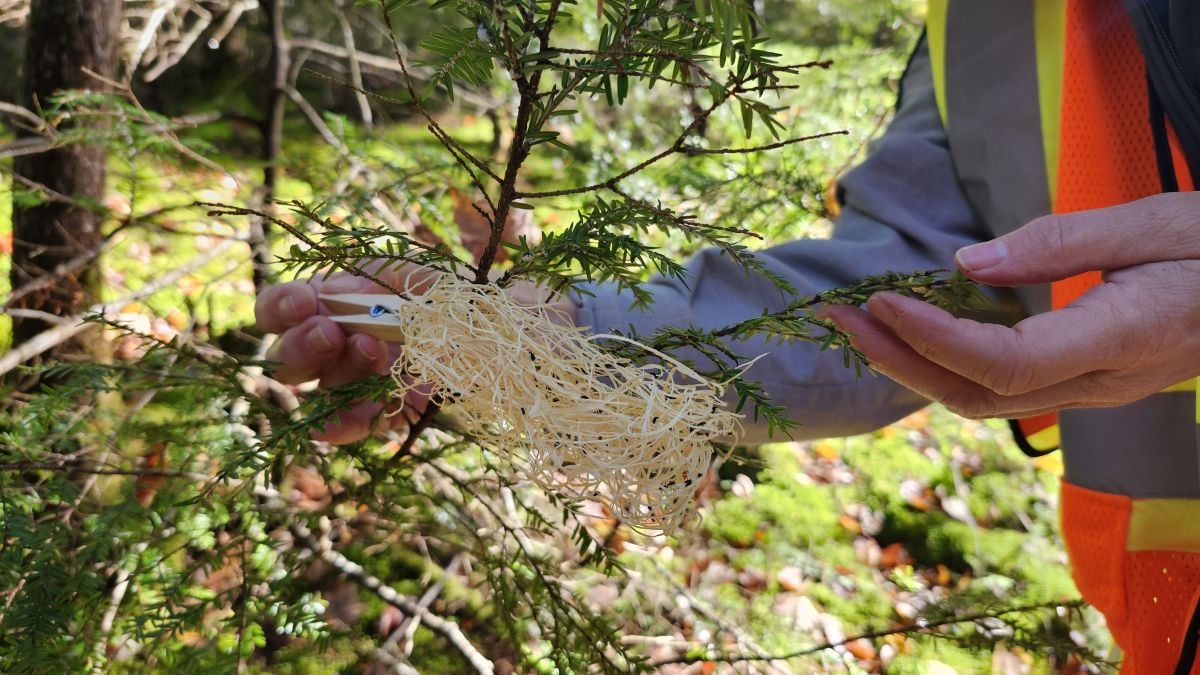
Hailing from East Asia, it has no natural predators in New England. Maine’s eastern hemlock trees are largely defenseless against the swarms of adults that pitch tents of protective white fluff and siphon sap from the tree’s deep green branches until the host dies.
The adelgid has wiped out scores of hemlocks in southern Maine and is creeping further inland each year, threatening to infiltrate the state’s so-called “hemlock belt” in the western mountains, where mature sections of Maine forests are nestled in the foothills.
In recent years, however, a coalition of Midcoast land trusts, private landowners and Maine Forest Service officials have ramped up their efforts to control the hemlock woolly adelgid by recruiting the help of a familiar foe: two species of beetle that prey on the adelgid in Asia and the U.S. Pacific Northwest.
It’s a counteroffensive that forest managers hope will knock back the adelgid to both relieve the recently infested hemlocks in the Midcoast and thwart the insect’s inland expansion.
“The more we do to reduce the population of hemlock woolly adelgid in the Midcoast area will probably [determine] how fast it moves into more inland areas and our big hemlock belts,” said Colleen Teerling, the Maine Forest Service entomologist overseeing Maine’s adelgid response.
Calling reinforcements
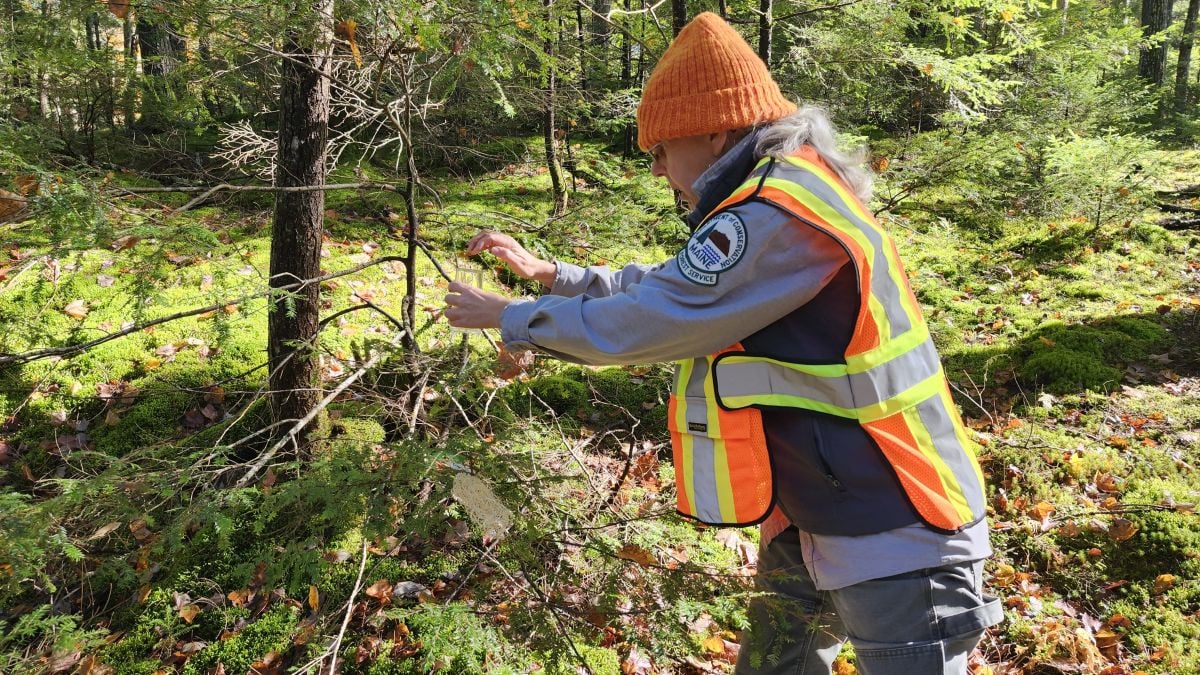
On a chilly October morning in Wiscasset’s Sortwell Memorial Forest, the latest batch of adelgid-eating beetles arrived in clear cylindrical containers shipped overnight from a lab at Virginia Tech.
The 90-acre forest is owned and managed by the New England Forestry Foundation and has a few prominent pockets of eastern hemlock in the early stages of hemlock woolly adelgid infestation, according to Brian Milakovsky, senior forester for the nonprofit.
That timing made the forest a good candidate for treatment, Milakovsky said, and helped the organization secure 525 Laricobius nigrinus beetles for free through the U.S. Forest Service.
Scientists and U.S. forestry officials have vetted both L. nigrinus and a similar species, Laricobius osakensis, to ensure they’ll only prey on the adelgid and not cause collateral damage in eastern North America. Initial research on L. nigrinus began in the late 1990s when scientists at Virginia Tech studied the beetle’s lifecycle and feeding behaviors in a quarantined laboratory.
Then, in 2001, the U.S. Department of Agriculture stepped in and created an adelgid taskforce, approving L. nigrinus for deployment in eastern forests. Hundreds of thousands of lab-grown L. nigrinus have been released since, with a recent study showing significant success in slowing adelgid reproduction in southern and mid-Atlantic states where adelgid first arrived.
With backup in hand, Milakovsky and Teerling extracted nests of the poppy seed-sized beetles from the cylinders and gently placed each colony on low-hanging hemlock branches.
Whether the beetles are successful in hunting down the white fluffy clusters of hemlock woolly adelgid won’t be clear for another year or two. The adelgid reproduces asexually and concentrates in the upper branches by the hemlock’s crown — making it and the beetle difficult targets to measure.
“It’s a black box,” Milakovsky said. “You release them. Then you really hope they’ll come back in a few years.”
|