|
Maine’s first turtle tunnel is working
In 2021, the Maine Department of Transportation partnered with federal and state wildlife agencies to install a wide culvert designed to help turtles, including the endangered Blanding’s turtle, safely cross a notoriously deadly section of State Route 236 in Eliot.
In the years since, tens of thousands of people have driven over this wildlife crossing, most of them unaware it is even there. And dozens of species, both shelled and non-shelled, have taken advantage of the underpass.
During a presentation Tuesday, biologists at the Maine Department of Inland Fisheries and Wildlife reported that the turtle tunnel — the first of its kind in Maine — is working.
“There’s been a substantial reduction in turtle mortalities,” Greg LeClair, a municipal planning biologist at the state agency, told a small crowd gathered at the Eliot Town Office. “Follow-up surveys have shown much fewer turtles being crushed on that section of road.”
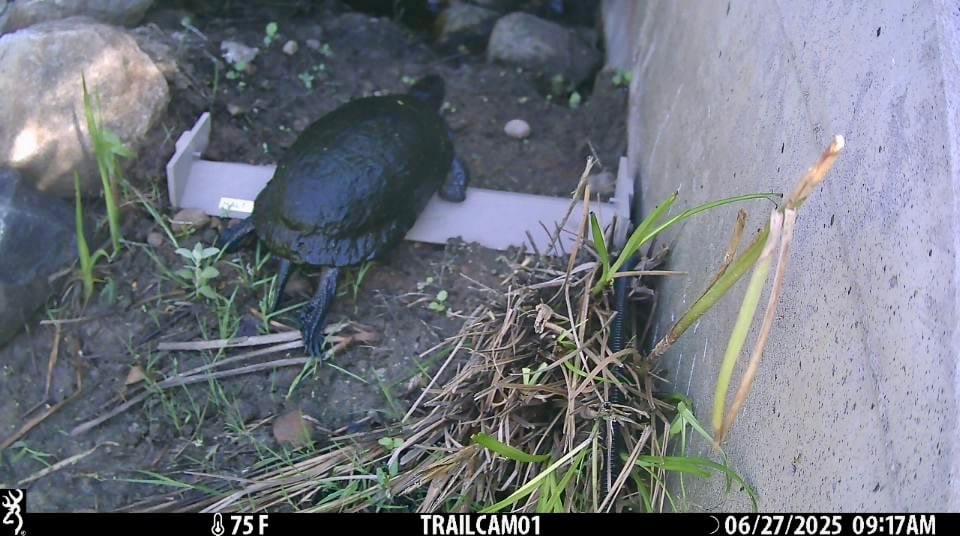
Last summer, the Maine Department of Transportation deployed special game cameras equipped with a light beam that can detect the movement of small, slow-moving critters. Shortly after 9 a.m. on June 27, the camera trap snapped a photo of a Blanding’s turtle lumbering through the tunnel, safe from buzzing traffic along what one former state biologist called “a highway of death” for shelled reptiles.
The 8-foot-wide, 6-foot-tall culvert connects wetlands on both sides of the busy state highway, including a nearly 100-acre section of conservation land managed by Great Works Regional Land Trust.
The wildlife underpass and roadside fencing, meant to steer wildlife toward the tunnel, cost approximately $400,000 to install, with Maine DOT contributing a large chunk of the funds to mitigate wetland disturbance from construction of the high-speed toll plaza on the Maine Turnpike in York.
While the Eliot tunnel was designed with Blanding’s turtles in mind, Maine DOT has documented a slew of other creatures passing through, according to Justin Sweitzer, the agency’s environmental coordinator for southern Maine. Over a period of nearly five months, the cameras snapped more than 270 photos of wildlife in the tunnel, ranging from snapping turtles and salamanders to muskrats and mink.
Not one Blanding’s turtle has been found dead on the road since the crossing was installed, according to the department. A small number of snapping turtles and painted turtles have been killed.
Blanding’s turtles are rare in Maine, found only in York County and the southern part of Cumberland County. The state listed the species as threatened in 1986 and upgraded it to endangered in 1997. Habitat loss and road mortality are among the biggest threats to these reptiles.
Unlike some other turtle species, Blanding’s move around a lot in search of food, often traveling to six wetlands per year, according to Kevin Ryan, a reptile and amphibian biologist at the Maine Department of Inland Fisheries and Wildlife.
“The closeness of the roads and the houses and the wetlands down in southern Maine means that throughout the course of its life, a turtle is going to come into contact with human infrastructure quite a bit,” Ryan said at Tuesday’s event.
The life cycle of Blanding’s turtles makes recovery efforts particularly challenging. The yellow-throated reptiles can live to be over 70 years old, with females not reaching sexual maturity until 14 to 20 years of age and often taking decades to produce an offspring that ultimately reaches adulthood.
“Losing one or two turtles actually matters,” Ryan said. “They’re not like a game species, something like a deer, rabbit, turkey, something like that, where a significant portion of the population can get harvested from year to year and then have it bounce right back.”
Peter Egelston, chair of the Eliot Conservation Commission, told The Maine Monitor ahead of the event that there is a growing awareness in the community about the importance of preserving wildlife habitat. He noted that Eliot residents adopted an updated comprehensive plan in June that emphasizes natural resource protection and building new trails, among other things.
“Communities are dealing with what seems like on the surface competing interests,” Egelston said. “There is a huge demand for housing. And yet there is also a huge desire to preserve open space. It’s one of the things that I think has caused a lot of communities to put a different shape to their approach to housing and zoning and so on, because in some ways what we really want to do is have the best of both worlds.”
Click here to watch a video of a Blanding’s turtle in the tunnel.
|