|
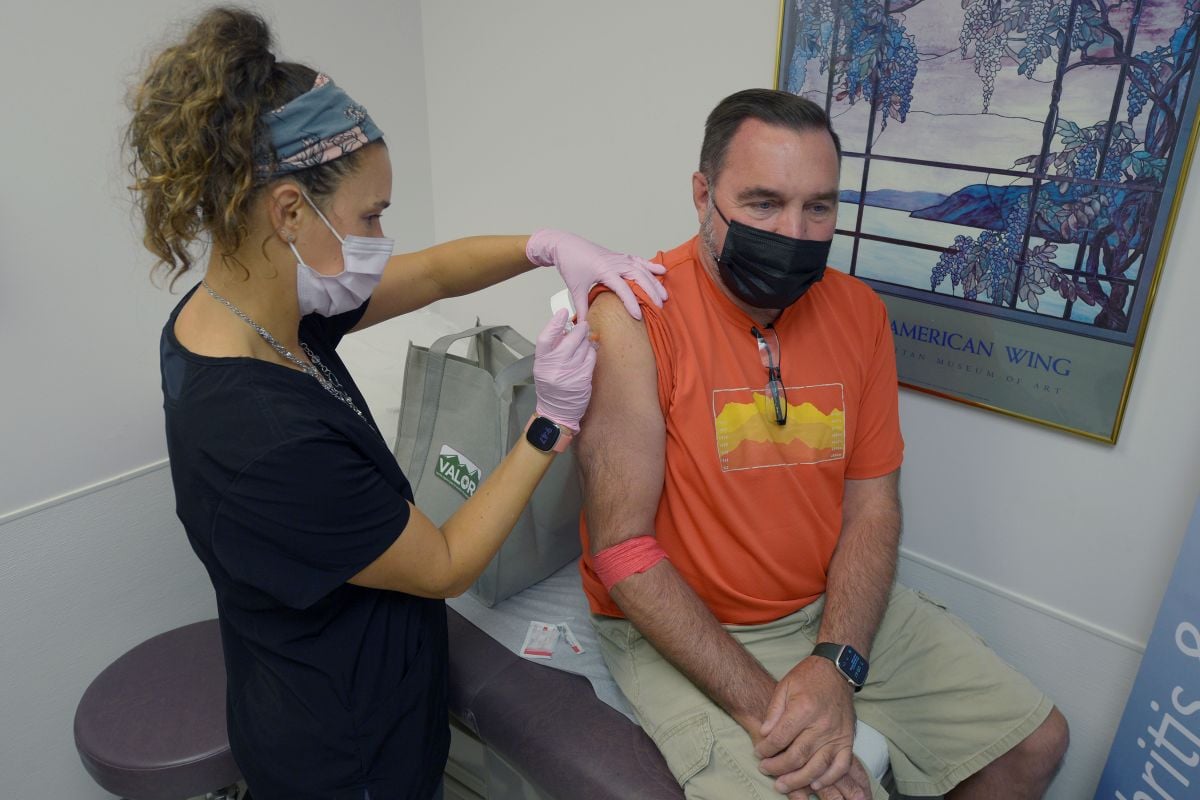
Robert Terwilliger, right, of Williamsburg, Pa., who participated in a Lyme disease vaccine trial at the Altoona Center for Clinical Research, was injected with either the new vaccine or a placebo, by registered nurse Janae Roland, in August 2022, in Duncansville, Pa. Lyme is a growing problem nationwide and particularly in Maine, with cases steadily rising and warming weather helping ticks expand their habitat. Photo by Gary M. Baranec of the Associated Press. |
|
|
|
Maine waited years for a Lyme vaccine. RFK hobbled the panel needed for a smooth rollout
By Kate Kaufman, Fitzgerald Reporting Fellow at The Maine Monitor
With rates of Lyme disease on the rise in Maine, physicians are eager for a Lyme vaccine to assist patients. One is on the horizon, but its future availability is up in the air because the Trump administration has effectively eliminated the federal committee that would provide guidance on the new vaccine.
The vaccine, developed by Pfizer in partnership with the pharmaceutical company Valneva, has completed its human trials. The companies are preparing to submit the final vaccine proposal to the U.S. Food and Drug Administration — but FDA approval is only one step in making the Lyme vaccine available.
After receiving FDA approval, a vaccine typically receives a recommendation from a group that has historically received little public attention: the U.S. Centers for Disease Control and Prevention’s independent Advisory Committee on Immunization Practices. The committee’s guidance has long been considered the gold standard for vaccination, and its recommendations inform which vaccines are covered by insurance and how physicians prescribe them.
But the Advisory Committee on Immunization Practices is currently unable to give recommendations. In 2025, U.S. Department of Health and Human Services Secretary Robert F. Kennedy Jr. fired every member of the advisory committee, and the 13 replacements he appointed drew legal backlash. A group of medical organizations filed a lawsuit in July 2025 claiming that the new committee members had not been thoroughly vetted and did not have the necessary credentials to provide scientific counsel.
With the lawsuit ongoing, a judge ordered in March that the committee cannot meet or create recommendations about new vaccines. |
|
|
| READ THIS STORY |
|
|
|
|
|
|
|
|
|
Want to know more about the potential Lyme vaccine? We’ve compiled answers to three main questions.
Where does the Lyme vaccine stand?
After a multi-year clinical trial, pharmaceutical companies Pfizer and Valneva have completed the necessary studies to submit the Lyme vaccine for approval from the U.S. Food and Drug Administration.
The clinical trial administered either four doses of the vaccine or four doses of a placebo to more than 9,000 patients at sites across the U.S. and Europe, including a number of study participants in Maine. The clinical trial found that the vaccine was generally well tolerated by the patients who received it and caused no safety concerns.
How effective is it?
In the clinical trial, the vaccine reduced Lyme infections by 73.2 to 74.8 percent.
However, the companies saw fewer total cases of Lyme disease during the trial than they expected, which meant their efficacy rate measurement could not be as statistically precise as the goal they had set. A spokesperson for Pfizer said this low case number could happen for several reasons, such as total incidents of Lyme infection being lower during the clinical trial period compared with prior years.
When could it be available to patients?
Pfizer has not committed to any timeline for FDA submission nor eventual rollout.
When the companies completed their clinical trials, initial reports stated that the vaccine could be available as soon as next year. However, because the trial did not meet its precision goal, experts predict that the process of preparing to apply to the FDA and receiving the agency’s approval may take longer.
The rollout process is also complicated by uncertainty in the U.S. Centers for Disease Control and Prevention’s independent vaccine recommendation committee. Ongoing litigation surrounding appointments to the panel have prevented it from making recommendations about new vaccines. |
|
|
|
|
|
|
|
Have feedback, a correction or know of something we should look into? Send it to our newsroom. You can also email The Monitor's editors: editors@themainemonitor.org.
The Maine Monitor is a publication of the Maine Center for Public Interest Reporting, an independent and nonpartisan nonprofit news organization that produces investigative journalism. We believe news is a public good and keep our news free to access. We have no paywall and do not charge for our newsletters. If you value the reporting we do for Maine, please consider making a donation! We cannot do this reporting without your support. |
|
|
|
|
|
|
|
|
|
|